Atradius Atrium
Get direct access to your policy information, credit limit application tools and insights.

 United States
 Australia
 Austria
 Belgium
 Brazil
 Bulgaria
 Canada
 China
China
 Czech Republic
 Denmark
 Finland
 France
 Germany
 Greece
 Group
Group
 Hong Kong SAR
 Hungary
 India
India
 Ireland
 Italy
Italy
 Japan
Japan
 Lithuania
 Mexico
 Netherlands
 New Zealand
 Norway
 Poland
 Portugal
 Romania
 Singapore
 Slovakia
 Slovenia
 Spain
Spain
 Sweden
 Switzerland
 Turkey
 United Arab Emirates
 United Kingdom
United States
United Kingdom
United States
After a 4.7% increase last year, global production growth of basic metals is expected to slow down to 0.5% in 2026. Output growth in Asia Pacific is slowing to 1.5%, mainly due to much lower output in China (The country accounts for almost 50% of global basic metals production). After contractions in 2024 and 2025, Europe will see just a feeble 0.2% growth this year, affected by high energy costs, competitive challenges, and trade disruptions due to US tariffs. In contrast, metals and steel production growth in North America is accelerating to 2.7%.
We expect global metals and steel output to rebound by 4% in 2027. This is because higher global industrial production (up 4.1%) and construction output (up 3.8%) will increase demand. Other growth drivers for metals and steel will include AI-related manufacturing across Asia and North America and rising investment in EVs, batteries, and electrical equipment, particularly in China. This should support basic metals demand, especially for non-ferrous metals.
Growth of global iron and steel production is expected to slow down to 2.1% this year, followed by a 3.8% increase in 2027. Excess capacity is currently weighing on the segment, and consolidation has been slow. In China, the prolonged construction slump has reinforced ongoing overcapacity, putting pressure on prices, and exports are increasingly distorted by tariffs in foreign markets. The US tariff on steel is currently 50% and the EU is following up with its own protective measures, such as reduced tariff-free import quotas and higher duties above quotas. The result of these measures is an increasingly fragmented global steel market, in which excess capacity and uneven state support continue to distort trade flows. The OECD expects excess steelmaking capacity to reach 745 million tonnes by 2028. Global overcapacities in the steel sector will remain an issue even if China succeeds in reining in production. This is because many emerging market economies, especially among India and Southeast Asia, plan to increase capacity by more than 100 million tonnes over the next few years.
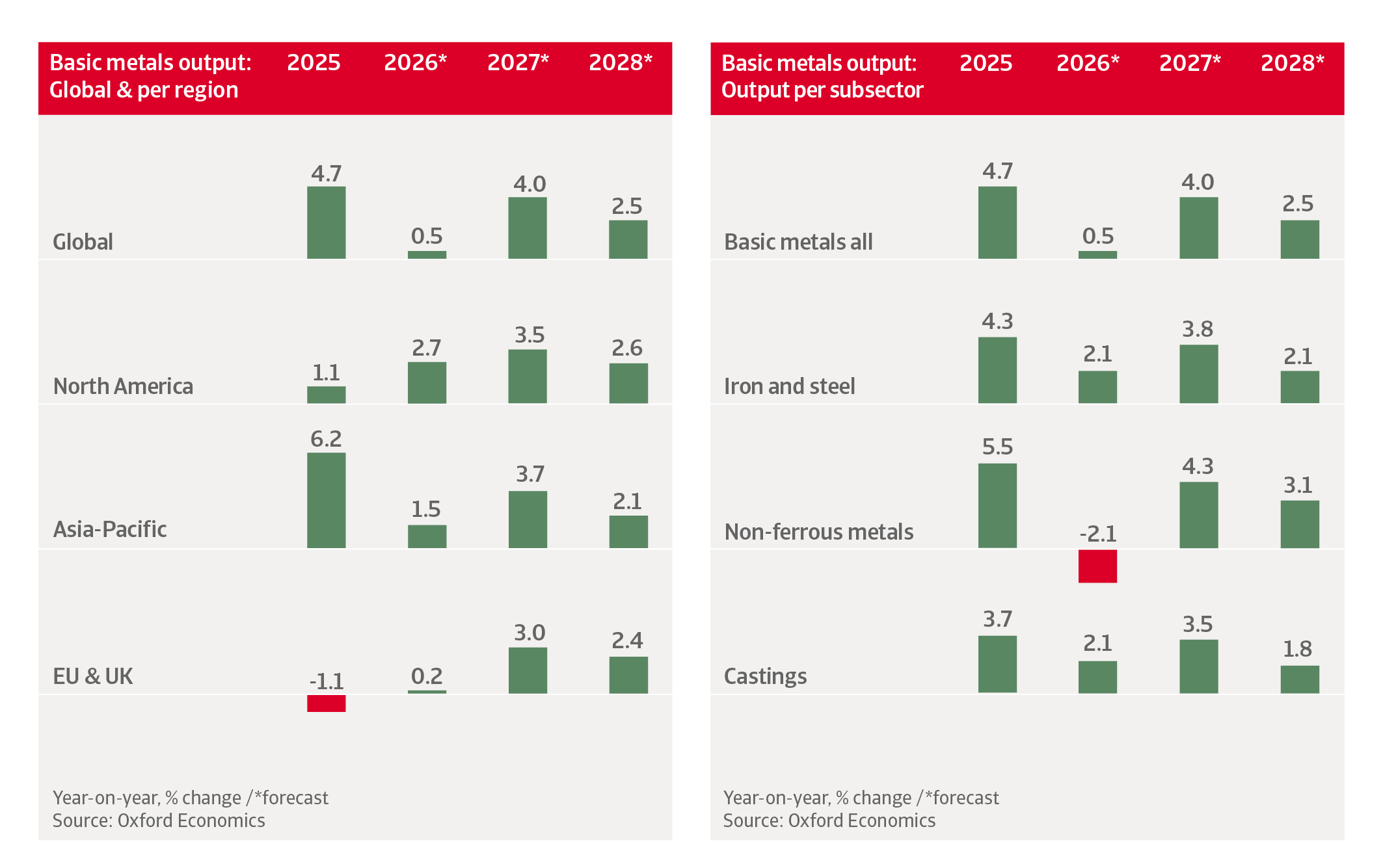
Output of non-ferrous metals is expected to contract by 2.1% this year, with production in the Middle East shrinking by 16.5%. Aluminium production, in particular, has been hit by the Iran conflict with disruptions to smelters and regional supply, of which the Gulf is a major provider. This has pushed prices higher, and there is limited ability to offset Gulf-supply losses quickly. Chinese output expansion is constrained by production caps and power-related pressures. Rapidly expanding Indonesian production will take time to fully offset disrupted Gulf availability. That said, inventories, spare capacity, demand adjustment and trade rerouting have helped to prevent widespread shortages and limit the scale of the price shock. The short-term outlook depends largely on the pace of supply normalization. Continued pressure on prices could be lessened with an end to conflict in the Gulf and improved shipping conditions. However, renewed disruption, or slower Asian supply growth, could keep prices elevated in the coming months.

We expect US basic metals production to increase by 3.5% in both 2026 and 2027. Iron and steel output is forecast to increase by 5.1% and 4.4% respectively, supported by trade protection, infrastructure investment, reshoring and demand from data centres, energy projects, and advanced manufacturing. However, elevated interest rates, trade policy uncertainty and softer residential and consumer-durables markets remain downside risks.
The April 2026 updates to Section 232 tariffs saw raw steel, aluminium, and copper locked into 50%, while derivative products were changed to a lower 25%. However, the tariff will be applied to the full customs value of a product, whereas previously the duty only targeted its metal content. The tariffs have reduced import competition and strengthened domestic pricing power. Finished-steel imports have declined materially, particularly for sheet and plate, while healthy order books and disciplined capacity have supported higher utilization and the margins of domestic producers. New capacity should gradually improve domestic supply, although long construction and commissioning periods limit the near-term response. Elevated US sales prices for steel compared with international markets could attract imports if trade protection weakens.
Production of US non-ferrous metals is expected to rise by 2.2% in 2026 and 3.2% in 2027. Aluminium demand remains supported by electrification, grid investment, transportation and data-centre construction, but limited smelting capacity and high power requirements are constraining domestic supply. The United States, therefore, remains dependent on imported aluminium, particularly from Canada, leaving downstream users exposed to tariffs and elevated regional premiums.
Energy prices are much lower in the US than in other regions, due to the size of US domestic energy production. Therefore, US metals and steel producers have a competitive advantage over their peers in Europe and Japan.
There's higher credit risk for leveraged service centres, processors, and import-dependent companies due to rising working capital needs
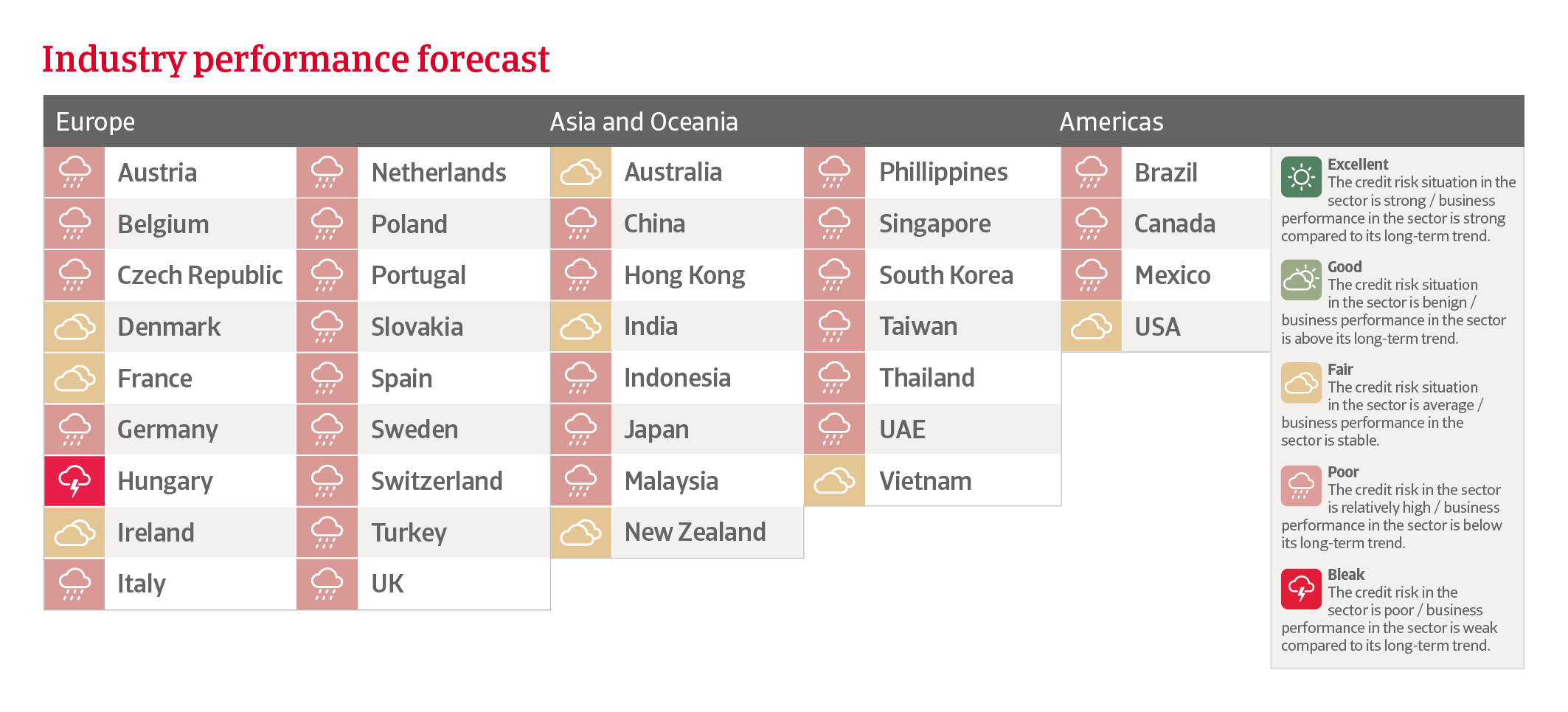
Credit risk conditions in US metals and steel industry remain benign for large, diversified producers. Risk is higher among leveraged service centres, processors and import-dependent companies facing increased working-capital needs, limited liquidity or difficulty passing on higher costs to customers.

Canada’s basic metals output is forecast to contract by 1.5% this year after a 6.4% decline in 2025. This is an illustration of how the industry is suffering from the 50% US import tariffs. Heavy dependence on the US as its primary export market leaves steel producers particularly exposed to lower shipments, domestic oversupply, and pressure on capacity utilisation and profitability. Although trade protection, “Buy Canadian” initiatives and public infrastructure investment should provide some support, they are unlikely to fully offset reduced access to the US market.
Consequently, near-term production is expected to remain under pressure, while the timing and strength of any recovery are highly uncertain. Producers are reducing output, controlling costs and adjusting workforces. In contrast, the aluminium segment remains comparatively resilient because US buyers depend on Canadian supply, and smelters benefit from competitive hydroelectric power. However, the tariffs increase delivered costs and are creating uncertainty around trade flows. Credit risk remains “Poor”, particularly for steel producers, service centres and processors with high fixed costs, elevated leverage, limited liquidity or significant exposure to US customers.

We expect annual output growth of Chinese basic metals to slow down to 0.1% in 2026 and to 1.9% in 2027, after growing 5.9% last year. Annual economic growth of about 4.5%, strength in advanced manufacturing, fiscal support and exports are currently sustaining demand. However, at the same time, the ongoing housing sector issues, weaker credit growth and trade-related disruptions are constraining expansion.
Steel output growth is expected to decrease to just 1.6% this year and 1.0% in 2027. The property sector, the main source of demand, shows little sign of recovery. Infrastructure spending is providing some support but cannot offset the drag from residential construction. Steel supply is exceeding demand, which has put prices and margins under increasing pressure. Export growth is offering only limited relief as many countries are increasingly applying trade protectionism against China’s steel exports. Thin margins and rising finished-steel inventories are resulting in curtailments and delayed procurement in the segment.
Traditional steel-intensive sectors are playing a diminishing role in economic growth as activity shifts towards higher-value manufacturing and services, while the prolonged property downturn appears less likely to attract the scale of policy support seen in previous cycles. This reduces the prospect of a sustained recovery in construction-led steel demand and suggests that any cyclical improvement in iron ore consumption is likely to be limited.
The non-ferrous metals subsector is faring better, as the government prioritizes advanced manufacturing, electric vehicles and renewable energy production. This segment is expected to grow by 1.6% this year and 2.9% in 2027. Aluminium has the strongest margins outlook, but China’s 45-million-tonne production cap limits supply growth. With long lead times for new projects and continued demand growth from power transmission and electric vehicles, market tightness is likely to persist. Exports have increased to take advantage of high prices elsewhere.
Credit risk in the Chinese metals and steel sector remains elevated due to the challenging business environment with low prices and margins. In particular, some financially weak and smaller players in the steel segment may encounter liquidity issues if they fail to source external funding.

Despite robust domestic economic growth, we expect the output growth of Indian basic metals to slow down to 7.9% in 2026 after increasing 18.2% last year. Rising energy costs, accelerating inflation, tighter monetary policy, and weakening investment sentiment are weighing on construction and manufacturing activity. Higher financing costs and pressure on corporate margins are dampening metals-intensive private investment and industrial demand. The phased implementation of the CBAM by the EU will increase costs for Indian steel and aluminium exporters, potentially reducing their competitiveness in European markets.
The outlook remains positive, supported by infrastructure investment, manufacturing expansion, and government-led industrialization initiatives. India’s rapid economic progress, urbanisation, and growing population will sustain metals and steel production in the mid to long-term. Steel production will remain the main driver of sector growth, supported by capacity additions and strong underlying demand from infrastructure, transport, and construction.

After a 2.5% contraction in 2025, we expect the output of Japanese basic metals to rebound only modestly, by 0.3% in 2026 and 0.7% next year. Demand is currently affected by the country’s low annual economic growth of just 0.5%. High energy costs and elevated uncertainty are weighing on manufacturing activity, construction, and investment, while higher input costs and lower corporate earnings are constraining metals consumption. Steel production is expected to contract this year, by 0.6%, as subdued demand from automotive and construction, along with persistent Chinese overcapacity, is keeping demand under pressure. Aluminium markets are also under strain, with Middle Eastern supply disruptions driving procurement costs sharply higher.
The planned introduction of an emission trading scheme is set to raise structural costs for blast furnace steelmaking, which still accounts for 75%. While implementation details remain uncertain, the policy direction reinforces the gradual shift to electric arc furnace production reshaping Japan’s demand profile and raw material requirements over the coming decade.

Demand for metals and steel remains supported by infrastructure investment, urbanisation and manufacturing-related foreign investment in Southeast Asia. That said, construction and residential demand vary considerably across individual markets. Regional production capacity is growing and could gradually reduce import dependence. In 2026 and 2027 gross output of basic metals in the ASEAN region is expected to grow by 5.2% and 7.9% respectively.
In the iron and steel segment, persistent global oversupply and ongoing price volatility are weighing heavily on margins across the region
Despite pockets of stable demand, the sector continues to operate under significant pressure. In the iron and steel segment, persistent global oversupply and ongoing price volatility are weighing heavily on margins across the region. Local producers face intense competition from Chinese and other imported steel, weak pricing from trade restrictions and, in some markets, elevated energy and raw-material costs. At the same time, high capital intensity and substantial capacity expansion has certainly elevated leverage for some producers. Additional investment requirements for decarbonization could further strain balance sheets over time. Vietnam and Indonesia are pursuing substantial capacity expansion. Thailand and Malaysia are exploring lower-carbon steel production and carbon-pricing measures, seeing demand from higher-value manufacturing sectors. Overall, the outlook remains challenging, with financial vulnerability most pronounced among smaller, highly leveraged producers with weak cost positions, limited product differentiation, or substantial refinancing needs.

After contractions in 2024 and 2025, we expect the EU’s basic metals output to rebound by a modest 0.7% this year. High energy prices, increased inflation and tighter monetary policy are weighing on industrial activity and consumer spending in the region. Demand from key end-use sectors, including construction, automotive, and machinery, remains subdued, while downside risks loom amid ongoing geopolitical uncertainty and energy market disruption.
The EU’s steel market is entering a protected phase, but not a conventional cyclical upswing. Since July 2026 annual import tariff-free quotas have been cut by about 47%, from roughly 34.5 million tonnes to 18.3 million tonnes, while the out-of-quota duty has doubled from 25% to 50%. From October 2026, new traceability requirements will tighten import controls by requiring verifiable evidence of where steel was originally melted and poured. This should make it harder to circumvent trade measures by routing steel through third countries into the EU. Additionally, the implementation of the EU Carbon Border Adjustment Mechanism (CBAM) has already begun to reshape import patterns in 2026, increasing the cost of carbon-intensive imports while encouraging domestic competition for greener steels.
Tighter trade restrictions and carbon pricing will lift European steel prices in 2026, but this will be a one-off repricing rather than a sustained rally. As tighter quotas and the CBAM curb lower-priced imports, hot rolled coil (HRC) prices are expected to increase by 13.1% to EUR 680 per tonne. Prices will ease slightly in 2027 before rising gradually to EUR 710 per tonne by 2030.
The 2027 recovery of steel demand is expected to be uneven across sectors and countries
Despite the safeguarding measures in place, EU steel production is only forecast to recover gradually. Output is expected to increase by 0.3% in 2026, as steel demand will receive little support from this year’s industrial cycle. EU industrial production is forecast to contract by 0.4% and manufacturing output by 0.7%. Additionally, the required restart of idled production lines could present new difficulties. In 2027 steel production is expected to increase by 3.8% as EU industrial production and manufacturing will increase by 2.2% and 1.9% respectively. However, the recovery will remain uneven across sectors and countries.
Steel demand from automotive as a key buyer sector will remain weak, weighing on demand for flat, coated and engineering steel, in particular in Germany and Central Europe. Changes in drivetrains and ongoing EV advancement has brought emphasis to ‘lightweighting’ production, encouraging substitutions towards aluminium and specialist alloys.
Construction will provide the broadest support to EU steel demand next year, led by residential and non-residential building, while energy transition projects, data centres, and grid investment provide additional momentum. This will benefit rebar, sections, structural steel, tubes, and selected plate products. However, fiscal restraint is constraining civil engineering activity outside Germany. Spain and parts of Southern Europe are best placed to benefit, whereas continued weakness in French construction activity will limit mainstream steel consumption there.
Growth in higher-value sectors will provide some demand increase. Aerospace output is forecast to rise by 6.1% in 2026 and 7.3% in 2027, supported by aircraft backlogs, defence procurement and capacity expansion. Investment in grids, defence electronics, and energy infrastructure will benefit specialist plate, forgings, and electrical steel producers.
Higher defence spending across the EU will have only a modest direct effect on aggregate steel volumes because production capacity for equipment such as armored vehicles remains limited. The indirect impact could be larger, however, through investment in factories, industrial buildings, and machinery. Germany’s infrastructure and defence stimulus will reinforce these sources of demand from 2027, although implementation bottlenecks will delay the uplift.
In the non-ferrous metals segment, supply-side factors are expected to dominate market developments. Aluminium markets remain vulnerable to supply disruptions in the Middle East and structurally high European energy costs, creating upside risks to premiums and prices.

We expect Germany’s basic metals output to rebound by 1.2% this year after four years of contraction. For quite some time the sector has suffered from weak demand from the key buyer industries automotive, construction and engineering, while the US import tariffs have been a blow to exports. The credit risk situation in the industry remains strained, as subdued demand, elevated energy costs, and low sales prices have deteriorated margins. Payment delays and insolvencies have increased over the past year, and the situation will remain tense in the coming months, especially among automotive suppliers and highly-geared companies. Most basic metals SMEs are dependent on credit lines in order to finance their working capital or to increase inventory. However, banks have increased checks before lending credit, often demanding more securities.
In 2027 we expect a 5% output growth. Production conditions should improve from late 2026 as government infrastructure spending, defence expenditure, and broader fiscal stimulus support industrial activity and metals and steel intensive investment. However, a full rebound to pre-pandemic levels is not on the cards for the coming years. Germany is by far the largest steel producer in Europe, and with 75% of its capacity using traditional blast furnaces, it is at a disadvantage to neighbouring countries as it will need to invest in cleaner technologies.

Output of basic metals and steel is expected to decrease by 5.9% in 2026 after a 13.4% contraction last year. This sharp contraction is in part caused by the closure of several blast furnace mills, which are being replaced by electric arc furnaces that should come online between late 2026 and early 2028. Metals and steel output is forecast to see another decrease in 2027, by 2.2%.
Demand conditions remain subdued, as weak economic growth, a restrictive monetary policy and tighter fiscal settings weigh on UK manufacturing activity, construction output and business investment. Higher energy costs and elevated geopolitical uncertainty are constraining metals consumption, and the EU’s new steel safeguarding regime could affect three-quarters of UK steel exports destined for the EU. Weak profitability, scarce internal funding, and fragile business confidence are likely to limit investment across the sector. Metals and steel manufacturers and suppliers continue to face unrelenting higher input costs, including wages and high debt servicing fees.
There is no expectation for significant demand recovery in the near-term. The few exceptions include the niche markets of aerospace alloys and battery metals. The environment favours a shift towards higher-value and niche-oriented production.
The nationalization of British Steel’s Scunthorpe plant has prevented capacity losses but does little on its own to address the competitiveness challenges that threatened its closure in the first place. Public ownership also doesn’t provide a clear route to the investment and modernization needed to restore commercial viability.
We expect the number of metals and steel insolvencies in the UK to remain elevated in the coming six months
For businesses reliant on debtor-backed funding models, the decrease in output and pricing has materially weakened the availability of funding. We expect the number of metals and steel insolvencies to remain elevated in the coming six months. Mainly at risk are those running heavily-stocked models without price mechanisms in place to adapt to further price fluctuations, as well as those reliant on expensive debt to support working capital.
The EU and the UK now apply broadly similar trade-defence measures, both using sharply reduced tariff-rate quotas and a 50% out-of-quota tariff. The EU offers stronger overall protection because these safeguards are reinforced by CBAM and the EU ETS, while the UK relies more heavily on conventional trade barriers and domestic industrial policy. The aim of both is to bring import penetration closer to historical norms and allow domestic metals and steel producers to regain market share. However, the measures cannot generate the broad-based demand recovery needed to restore steel and metals production to pre-pandemic levels. Steel production in Western Europe will rise only gradually over the decade, and is forecast to reach 102.8 million tonnes by 2030 – which is still more than 12% below its 2019 level.
Increased selling prices should spur a rise in production in the mid-term, but Europe’s structural cost disadvantages are likely to constrain the profitability of its metals and steel businesses. High electricity and gas prices, grid constraints, limited access to capital and the cost of decarbonization will restrict investment and prevent stronger pricing power from translating fully into higher margins or output.
Energy costs remain the main issue. Electricity and gas prices in the EU and the UK are higher than in rival markets, eroding margins and curbing investment. Grid expansion and improvements in supply security and resilience should ease these pressures over time, but offer limited relief in the near term.
The recent import curbs will support European steel producers, but raise costs for downstream sectors such as automotive, machinery, and fabricated metals
Decarbonisation will change metals and steel making rather than cut costs. A shift towards electric arc furnaces cuts reliance on iron ore, metallurgical coal, and direct carbon costs, but increases reliance on cheaper electricity, grid access, good scrap, and other metallics such as direct reduced iron and hot-briquetted iron. Low-carbon steel costs more than conventional steel, so must earn a price premium to be viable unless policy closes the cost gap. According to the current requirements Europe’s metal and steel industry has limited time to deliver decarbonization. Global overcapacity, lower European utilization rates, and stronger return on investment in other industries are weakening the case for private capital, making substantial state support for decarbonization investment increasingly necessary.
The recent import curbs will support European steel producers, but raise costs for downstream sectors such as automotive, machinery, and fabricated metals. This is particularly challenging as many of these industries face growing competition from Chinese imports that may not bear equivalent trade or carbon costs.
Download the full report in the related documents section below.
To explore how to strengthen your own credit risk strategy, get in touch with us and see how we can help you stay ahead.


